
Table of Contents
- Best Techwear Brands for 2026: How to Choose
- What Separates Real Techwear from Fast Fashion
- Affordable Techwear Brands That Still Perform
- Urban Techwear Brands Built for City Life
- Techwear Outfit Ideas for Every Season
- How to Style Techwear Without Looking Costume-y
- Key Features to Compare Across Techwear Brands
- Common Mistakes When Buying Techwear
- Conclusion: Building a Techwear Rotation That Lasts
- Frequently Asked Questions
Last Updated: October 16, 2026
Best Techwear Brands for 2026: How to Choose
The best techwear brands for in 2026 treat fabric engineering and urban function as the product, not the marketing.
Technical apparel searches keep climbing, and the market has filled with brands that borrow the vocabulary without the construction. Below, we break down what separates the two, then cover the affordable, urban, and styling decisions that shape a rotation.
What Separates Real Techwear from Fast Fashion
Real techwear is functional clothing engineered around weather protection and movement, where fabric technology and construction do the work.
The tell is in the details: a genuine shell lists its waterproof rating, breathability, and seam sealing. A fast-fashion version lists a vibe.
Check these markers before you buy:
- Named fabric technology rather than a vague "premium material" claim
- Taped or sealed seams, not just a water-resistant coating on the face fabric
- Articulated sleeves and gusseted panels for mobility, not a straight tube cut
A common mistake is trusting the product photo. Technical fabrics photograph almost identically to coated imitations.
Affordable Techwear Brands That Still Perform
Affordable techwear is possible because the cost drivers are fabric and construction, not brand name. You can find genuine performance wear at lower price points if you know which corners are safe to cut.
We score affordable techwear on five weighted factors:
- Weather protection (30%), rated membrane, taped seams, water-resistant zips
- Construction quality (25%), stitch density, hardware durability, seam finish
- Fit and mobility (20%), articulated sleeves, gusseted panels, true-to-size grading
A cheap shell with unsealed seams fails the first criterion and should not rank, no matter how good the photos look.
What "affordable" actually means in 2026
Price bands shift with tariffs, fabric costs, and season, so treat these as orientation, not gospel:
- Entry tier (roughly under $150 for a shell): expect a 2.5-layer or coated 2-layer construction, critically taped seams on the main body, and a DWR finish that needs reapplication after a season of washing. Breathability is the compromise.
- Mid tier (roughly $150-$350): 2.5-layer or 3-layer membranes become realistic, pit zips appear, and hardware upgrades to metal or quality composite. This is where most readers get the best cost-per-wear.
- Premium tier (roughly $350+): 3-layer laminates, fully taped seams, and repair programs. Worth it if you wear the piece more than 60 days a year.
Brands that consistently deliver value at the entry and mid tiers
These names come up repeatedly in long-term wear reports and spec-sheet comparisons. We are not affiliated with any of them; we include them because they meet the construction markers above.
- Uniqlo (Blocktech and PUFFTECH lines), the Blocktech shell is the most common entry point for a real membrane without designer markup. Seams are taped, the DWR is decent, and the price sits in the entry tier. The trade-off is a boxier cut and limited breathability.
- Decathlon (Quechua and Forclaz), the value benchmark for outdoor-derived technical wear. Their MH500 and MT100 shells routinely hit the entry tier with taped seams and a rated membrane. Sizing runs European; check the chart.
- Columbia (Omni-Tech line), the most widely available mid-tier option in North America. Omni-Tech is a proprietary waterproof-breathable membrane, and OutDry Extreme uses an external membrane that resists wetting-out better than most DWR-dependent shells.
Where budget brands cut corners, and where they don't
Safe cuts are cosmetic: simpler colorways, fewer pockets, no collaboration markup. Unsafe cuts are structural: unsealed seams, thin face fabrics, plastic hardware that cracks in cold weather. Prioritize in this order:
- Weather protection first. A plain shell that actually keeps rain out beats a feature-stuffed jacket that does not.
- Mobility second. Check that you can raise your arms and squat without the hem riding up.
- Pocket layout third. Utility pockets are useful, but they are the easiest feature to live without.
- Aesthetics last. This is where budget brands compete hardest, and where you can compromise without losing function.
How to read a spec sheet like a buyer, not a fan
Most affordable techwear fails because the buyer misread the spec, not because the brand lied. Three terms do most of the damage:
- "Water-resistant" vs. "waterproof." Water-resistant fabric handles light rain and sheds quickly. Waterproof construction, with sealed seams and a rated membrane, handles sustained weather. Confusing the two leaves you soaked on the one day it matters.
- Hydrostatic head (mm). The waterproof rating. Common thresholds: 5,000mm for light rain, 10,000mm for sustained rain, 20,000mm for heavy or prolonged exposure. Below 5,000mm, treat the piece as a windbreaker, not a rain shell.
- Breathability (g/m²/24h or RET). Higher g/m²/24h is better; lower RET is better. Entry-tier shells often omit this number because it is unflattering. If a brand will not publish it, assume the worst.
For a fuller picture of how current technical apparel is being positioned across the market, industry coverage of functional fashion trends is worth reading alongside your own spec-sheet comparisons.
Urban Techwear Brands Built for City Life
Urban techwear is technical apparel tuned for the city rather than the trail: lighter shells, quieter fabrics, and pocket layouts built around a phone, a wallet, and transit.
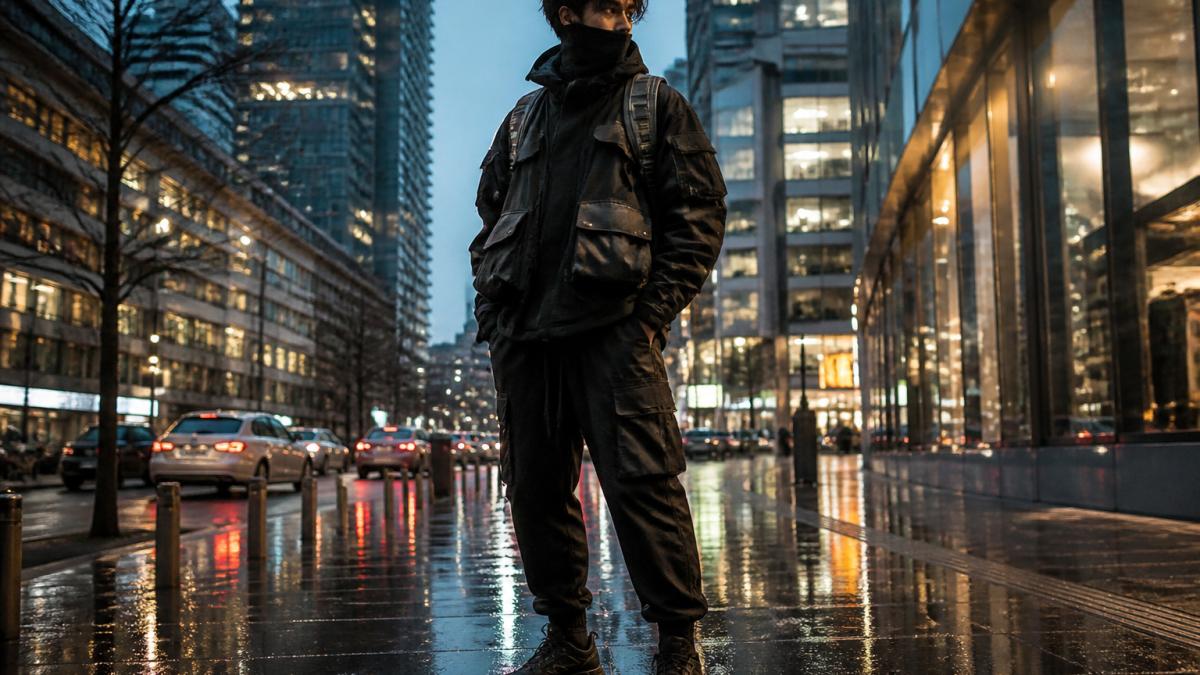
City life demands windproof and water-resistant more than extreme insulation, breathable fabric for moving between heated interiors and cold streets, and layering that works in a warm office and a cold evening.
Look for these in an urban piece:
- A lightweight shell you can fold into a bag
- Cargo pants with real pocket depth, not decorative flaps
- Minimalist design that reads as clothing, not costume
This is where the cyberpunk aesthetic and everyday wear overlap most comfortably.
Techwear Outfit Ideas for Every Season
Techwear outfit ideas work best when you build around layers instead of single statement pieces. A modular approach means the same core garments cover spring rain, summer heat, and winter wind.
Here is a simple seasonal framework:
| Season | Base Layer | Mid Layer | Outer Layer | Key Piece |
|---|---|---|---|---|
| Spring | Lightweight tee | Softshell | Packable shell | Water-resistant shell |
| Summer | Breathable tee | None | Light overshirt | Cargo shorts |
| Autumn | Thermal tee | Fleece | Shell jacket | Utility vest |
| Winter | Thermal base | Insulated mid | Hardshell | Insulated shell |
The point is to buy fewer pieces and wear them more: a packable shell that works in spring also works over a fleece in autumn. That is cost-per-wear thinking, and it is how a rotation stays affordable.
How to Style Techwear Without Looking Costume-y
Styling techwear is mostly about restraint. The garments already carry strong functional details, so let one or two pieces lead and keep everything else quiet.
The costume look comes from stacking every technical element at once: cargo pants, harness, tactical vest, and a shell, all in black, all with straps.
Our approach is simpler:
- One technical statement per outfit. Let the jacket or the pants carry the look.
- Keep the palette tight. Two or three colors maximum, with neutrals doing the work.
- Mix technical with ordinary. A shell over plain denim reads as style. A shell over tactical trousers reads as a costume.
For people coming from traditional streetwear, the transition is easier than it looks. Technical fabrics already fit the streetwear silhouette.
Key Features to Compare Across Techwear Brands
Most "best techwear brands" lists rank on vibe. We rank on five measurable factors, weighted so performance and construction carry the most influence. Here is the methodology, so you can audit our reasoning or apply it yourself.
Our ranking methodology
Each brand is scored 1-5 on five factors, then weighted:
| Factor | Weight | What we look at |
|---|---|---|
| Fabric technology | 25% | Named membrane, published waterproof and breathability ratings, DWR type |
| Construction quality | 25% | Taped vs. sealed seams, hardware material, stitch density, zipper type |
| Fit and mobility | 20% | Articulation, gusseting, size range, true-to-size grading |
| Price-to-durability | 20% | Cost per season of expected wear, repairability, warranty |
| Availability and returns | 10% | Regional shipping, return window, restock cadence |
A brand that scores 5 on aesthetics but 2 on construction will not rank, because aesthetics is not a weighted factor. That is deliberate: aesthetics is the easiest thing to fake and the hardest to verify from a spec sheet.
What the numbers actually mean
This is where most buyers get lost, and where most competitor lists stay vague.
Waterproof rating (hydrostatic head, in mm). This measures how much water pressure a fabric resists before it leaks. Common industry thresholds:
- Under 5,000mm, light rain, short exposure. Treat as a windbreaker.
- 5,000-10,000mm, sustained rain, commuting, urban use.
- 10,000-20,000mm, heavy rain, extended outdoor exposure.
Breathability (g/m²/24h, or RET). How much moisture vapor the fabric moves away from your body.
Seam sealing. Two constructions matter:
- Critically taped seams, only the seams most exposed to rain are taped. Cheaper, lighter, adequate for urban use.
- Fully taped seams, every seam is taped. Heavier, more expensive, necessary for sustained weather.
If a listing says "waterproof" but does not say which seams are taped, assume critical taping at best.
DWR (durable water repellent). The finish that makes water bead on the face fabric.
Fit, sizing, and accessibility
This is the factor competitors skip, and the one that most often determines whether a purchase actually works.
- Size range. Brands that stop at XL exclude a large share of buyers. Look for extended sizing; a few technical brands now offer 3XL and beyond, but coverage is uneven.
- Grading. European and Japanese brands often run one to two sizes smaller than US labels. Always check the brand's own size chart, not a third-party conversion.
- Layering fit. A shell should fit over your mid layer without compressing it. If you plan to layer a fleece, size up on the shell, the easiest fix for a rotation that stops working in cold weather.
Availability, shipping, and returns by region
A brand you cannot buy, ship, or return is not a recommendation. Before you commit:
- Check regional availability. Some brands ship globally; others restrict to North America, the EU, or Japan. Customs and duties can add meaningfully to the landed price.
- Check the return window. Fit varies wildly across brands. A 30-day return window is the practical minimum for a first purchase from an unfamiliar label.
- Check restock cadence. Limited drops that never restock make it hard to replace a worn piece. Brands with a predictable seasonal cadence are easier to build a rotation around.
Independent testing and long-term wear
We distinguish editorial recommendations from brand promotion by looking for evidence outside the brand's own marketing:
- Long-term wear reports from owners who have worn the piece through at least one full season
- Care and repairability, does the brand publish care instructions, and does it offer repairs or replacements?
- Durability over time, how the DWR, membrane, and hardware hold up after repeated washing and abrasion
A garment you can repair lasts years longer than one you replace. research on clothing durability and extended product life makes the case that construction quality and repairability are the real sustainability levers in apparel.
The scoring checklist
Use this when you evaluate any brand:
- Does the brand name its fabric technology and publish waterproof and breathability ratings?
- Are seams taped or sealed on any waterproof piece, and does the listing say which seams?
- Does the fit allow full arm and leg movement, with articulation or gusseting?
A garment you can repair, in a size that fits, from a brand you can actually return to, will outlast a hyped piece every time.
Common Mistakes When Buying Techwear
The most common techwear buying mistakes are paying for aesthetics over engineering, buying the wrong size for layering, and trusting hype over wear reports. Each costs you money and function.
Watch for these:
- Buying the look without the spec. If the listing does not name the fabric or the waterproof rating, assume it is neither.
- Sizing for a single layer. Techwear is a layering system. Buy the shell to fit over your mid layer.
- Trusting "limited" claims without evidence. Exclusivity is easy to claim and hard to verify. Look for a clear release structure, not just the word.
Conclusion: Building a Techwear Rotation That Lasts
The challenge with techwear is that the market rewards hype over engineering, and most buyers only discover the difference after a season of wear. Building a rotation that lasts means choosing construction over branding, layering over single pieces, and function over costume.
At GOODVIBE, that is the same standard we hold our own inventory to. Our CORE and RETRO CORE lines are built around the cohesion between earth and code, blending SoCal streetwear with the XRPL digital frequency, and our limited drops give you access to pieces designed to sit in a real rotation rather than a display case.
Frequently Asked Questions
What should I look for when buying techwear?
Focus on fabric technology first: waterproof and breathable membranes, taped seams, and durable water-repellent finishes. Check garment construction details like YKK zippers, reinforced stress points, and adjustable hoods. Look for ergonomic fit and mobility features such as articulated sleeves and gusseted underarms. Utility pockets and modular design add function. Finally, compare price range against expected wear frequency. A higher upfront cost often means better durability and lower cost-per-wear over time. Always read sizing charts because techwear brands often run differently from standard streetwear.
Which techwear brands are affordable?
Affordable techwear brands typically use simplified construction and fewer premium materials while still offering water-resistant finishes and functional details. Look for brands that prioritize core features like windproof shells and breathable linings over luxury branding. Price range varies widely, so compare cost-per-wear rather than sticker price. Budget-friendly options often release seasonal collections with limited colorways, so availability can fluctuate. Check return policies and shipping costs, since these can add up. Start with one versatile shell jacket or a pair of cargo pants before investing in a full outfit.
Is techwear practical for everyday wear?
Yes, techwear is designed for everyday wear when you choose pieces that balance function with minimalist design. A lightweight shell jacket, breathable base layer, and cargo pants with utility pockets handle commuting, urban exploration, and outdoor performance. The key is layering: start with moisture-wicking fabrics, add insulation, and finish with a weather-resistant outer layer. Avoid overly aggressive cyberpunk aesthetic details if you want versatility. Many urban techwear brands now offer toned-down silhouettes that fit into a regular rotation alongside standard streetwear.
What is the difference between techwear and gorpcore?
Techwear leans toward futuristic style, avant-garde design, and cyberpunk aesthetic influences, with an emphasis on functional fashion and modular design. Gorpcore borrows from outdoor apparel but focuses on trail-ready gear worn casually, often with a more rugged, less structured look. Techwear typically features darker palettes, articulated seams, and utility pockets integrated into a sleek silhouette. Gorpcore favors fleece, puffer layers, and hiking footwear. Both prioritize performance wear and weather protection, but techwear is more intentional about garment construction and technical fabrics as a design statement.
Building a techwear rotation that actually works comes down to one decision: buy for function, or buy for the photo. GOODVIBE exists for the first option, with CORE and RETRO CORE collections that bridge SoCal streetwear and the XRPL digital frequency, plus exclusive limited drops that reward the people building a real wardrobe. Get started with GOODVIBE and build a rotation engineered to last.