
Last Updated: November 7, 2026
Quick Summary
Web3 fashion in 2026 is defined by phygital apparel, where a physical garment is paired with a digital counterpart such as a token or digital twin. Blockchain works best as a record-keeping layer for provenance, digital product passports and resale history, while interoperability across wallets, chains and virtual worlds remains the main limitation.
- Phygital apparel pairs a physical garment with a digital token, twin or wearable for virtual worlds.
- On-chain provenance helps resale buyers verify authenticity, while digital product passports support supply-chain transparency.
- Durable digital collectibles tend to have a real community, capped supply and a link to something physical.
- Before buying, confirm total supply, supported wallets and platforms, and what the digital layer unlocks.
- Wallet complexity, price sensitivity and trust are the three barriers holding web3 fashion back.
Table of Contents
- Web3 Fashion Trends for 2026: The Shifts That Actually Matter
- What Is Phygital Apparel and Why It Defines 2026
- Phygital Fashion Examples You Can Actually Wear
- Blockchain in Fashion: Provenance, Passports and Resale Value
- Digital Fashion Collectibles: What Holds Value and What Doesn't
- Interoperability: Wallets, Virtual Worlds and Cross-Chain Wearables
- The Barriers Holding Web3 Fashion Back in 2026
- Building Your Earth-and-Code Rotation with GOODVIBE
- Frequently Asked Questions
Web3 Fashion Trends for 2026: The Shifts That Actually Matter
Web3 fashion trends in 2026 are less about hype and more about infrastructure. The digital fashion market keeps expanding, yet most of the real movement sits in unglamorous places: provenance tags, resale tracking and wallet-linked drops. This guide separates the signals from the noise.
The core tension is simple. Fashion technology has matured faster than consumer adoption. The Interline's coverage of Lectra's five key trends notes that digitalization and Industry 4.0 technologies have shifted from optional to necessary for fashion businesses. That's an industry-side shift, not a shopper-side one. Most buyers still don't know what a digital product passport is.
Here's what most guides get wrong: they treat every blockchain experiment as a trend. In practice, only a handful of use cases have stuck.
What Is Phygital Apparel and Why It Defines 2026
Phygital apparel is a physical garment paired with a digital counterpart, usually a token, a digital twin or a wearable for virtual worlds. The physical piece carries the identity; the digital layer can carry proof, perks or a resale record.
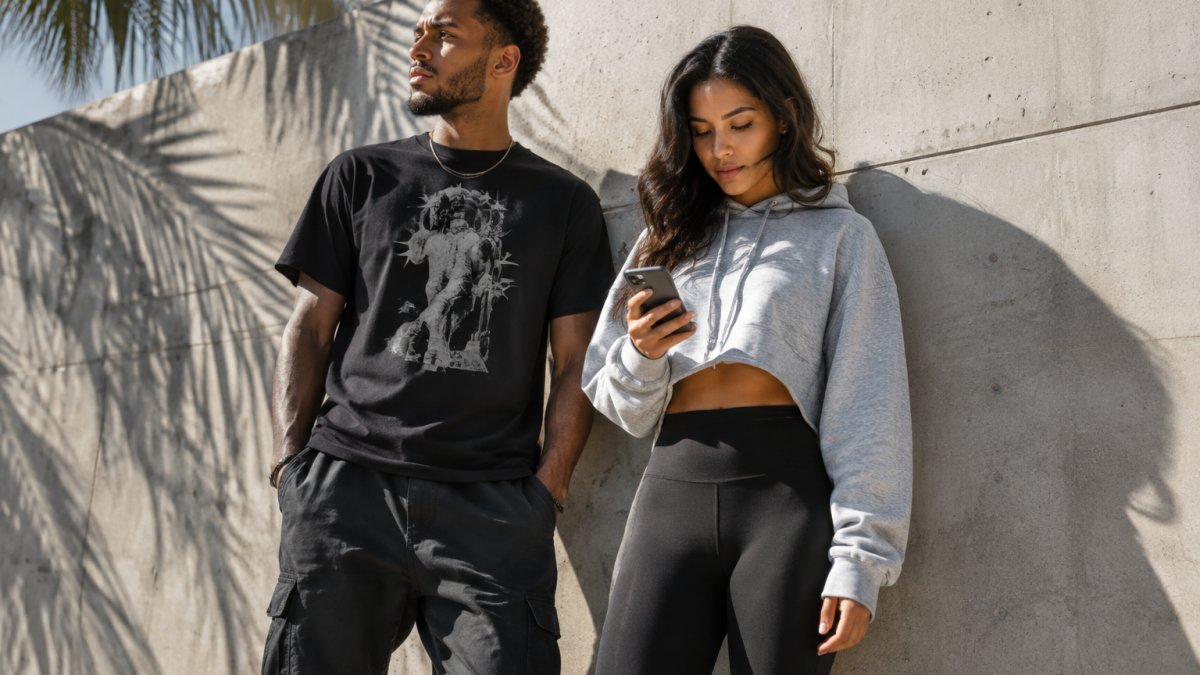
The concept has moved from concept-store novelty to a defining trend. According to Style3D's 2026 digital fashion trend report, consumers increasingly expect a physical shirt to come with a 3D digital counterpart. That expectation changes how brands design, ship and support a garment.
For a deeper breakdown, our complete 2026 guide to phygital apparel walks through how the physical and digital halves connect.
Phygital Fashion Examples You Can Actually Wear
Most phygital fashion examples fall into three practical categories:
- Scan-to-own tees. A printed graphic links to a digital claim, giving the buyer a token tied to that specific garment.
- Drop-linked hoodies and caps. Limited releases where the physical item and the digital record ship together.
- Wearable-first pieces. Garments designed to look right on a body and on an avatar.
Our own CORE line is built around this idea. The STATIC & SUN CORE "Circuit Trace" CVC Tee pairs a PCB schematic graphic with the STATIC & SUN identity. The Women's "Circuit Trace" Boxy Tee carries the same artwork on a relaxed cut.


If you want more options beyond our own line, we've rounded up phygital streetwear picks worth wearing.
Blockchain in Fashion: Provenance, Passports and Resale Value
Blockchain in fashion works best as a record-keeping layer, not a marketing gimmick. An on-chain provenance record lets a buyer verify where a garment was made, who owned it and whether it's authentic. A digital product passport extends that idea: a scannable record attached to the item for its whole life.
Where this pays off:
| Use case | What it solves | Who benefits most |
|---|---|---|
| On-chain provenance | Counterfeit risk | Resale buyers |
| Digital product passport | Supply-chain transparency | Brands and regulators |
| Tokenized ownership | Resale and repair history | Collectors |
| Authentication tags | Trust at point of sale | First-time buyers |
Digital Fashion Collectibles: What Holds Value and What Doesn't
Digital fashion collectibles are tokenized garments or wearables that exist only in digital form. Some hold value; most don't. The ones that last tend to share three traits: a real community, a capped supply and a clear link to something physical or experiential.
The four formats you will encounter in 2026
- Wearable NFTs for avatar platforms. Items minted for a specific virtual world or social platform, worn by an avatar rather than a body. Value depends almost entirely on whether the platform stays active and keeps the item compatible.
- Digital twins of physical garments. A token issued alongside a real piece, usually redeemable for the physical item or tied to its resale record. These tend to hold value because the digital layer is anchored to something tangible.
- Brand-issued collectible drops. Limited mints from fashion houses or streetwear labels, often bundled with early access to future physical releases. Value tracks the brand's continued relevance and whether the promised perks actually ship.
- Open-edition and generative pieces. Large or unlimited mints, sometimes generated by an algorithm. These are the most speculative and the most likely to be worthless after the drop window closes.
What actually signals durability
A capped supply is only meaningful if the issuer honors it. A common pattern is a "limited" drop that quietly restocks or mints a second wave, which erodes the scarcity the buyer paid for.
What doesn't hold value
Open-edition drops with no utility, collectibles tied to a brand that vanishes, and anything sold purely on hype. If a "limited" drop keeps restocking, it isn't limited.
A practical checklist before you mint or buy
- Confirm the total supply and whether the contract allows further minting.
- Check which platforms or wallets recognize the item today.
- Ask what the digital layer unlocks, resale record, repair history, event access, or nothing.
- Look at whether the issuer has delivered on past drops.
(page:3) shows how a tokenized layer can connect to physical purchases rather than float free of them, the digital piece earns its keep by tying back to a garment you can wear.
Interoperability: Wallets, Virtual Worlds and Cross-Chain Wearables
Interoperability is the make-or-break issue for Web3 fashion. A wearable that only works in one world, or a token that only lives on one chain, limits its own value. Cross-chain interoperability and wallet portability are what let a digital garment travel with its owner. Most top-ranking guides stop at that sentence.
The three layers a digital garment has to cross
- Wallet layer. The item lives in a wallet, and the wallet has to be recognized by the platform where you want to wear or display it. A garment held in a wallet the platform doesn't support is effectively invisible, even if the token exists.
- Chain layer. A token minted on one blockchain is not automatically readable on another. Bridges and cross-chain standards exist, but each adds friction and a new failure point. A common pattern is a brand minting on a low-fee chain for cost reasons, then discovering that the virtual world it wants to partner with only reads a different chain.
- Platform layer. Even on the same chain, a virtual world has to choose to render a given item format. Avatar wearables are not yet a single universal file type, so a garment built for one world often needs a separate build for another.
What this means for a buyer
Before you buy, ask three questions and expect clear answers:
- Which wallet does this live in, and does the platform I care about support that wallet?
- Which chain is it on, and can I move it without losing the provenance record?
- Which platforms currently render it, and is there a stated plan for more?
Brands that answer all three clearly are the ones building for the long term. Brands that answer vaguely are usually selling a single-platform item with a cross-platform story.
The honest limitation
True cross-world wearability is still early. Interoperability today often works best within a single ecosystem and can degrade across ecosystems.
Vogue's guide to Web3 for fashion executives flags blockchain-based digital assets, including digital fashion and collectibles, as an early fashion use of Web3.
The Barriers Holding Web3 Fashion Back in 2026
Adoption friction is the real story. Three barriers dominate:
- Wallet complexity. Most shoppers don't want to manage seed phrases to claim a tee.
- Price sensitivity. Digital layers add cost that buyers can't always justify.
- Trust. Past hype cycles left buyers wary of "exclusive" claims that didn't hold.
There's also a perception problem. Many shoppers assume crypto-branded apparel is a logo slapped on a blank. That's a fair concern, and the answer is quality and design, not louder marketing.
For skeptics who want straight answers on how a phygital brand actually bridges physical and digital, our frequency interrogation FAQ covers the basics.
Building Your Earth-and-Code Rotation with GOODVIBE
A rotation that works mixes one statement piece with everyday staples. Start with a graphic tee as the anchor, layer a cap for structure, and add a warmer piece for cooler days.
| Piece | Price | Role in the rotation |
|---|---|---|
| "Circuit Trace" CVC Tee | $26.99 | Everyday anchor |
| "Cyberburst Horizon" CVC Tee | $26.99 | Statement graphic |
| Women's "Circuit Trace" Crop Hoodie | $54.99 | Layering piece |
| "Pixel Sun" Retro Trucker | $24.99 | Everyday cap |
| "Dual Frequency" Retro Trucker | $24.99 | Statement cap |
Price

Best for: buyers who want phygital style they can actually wear daily. Skip if: you want purely digital collectibles with no physical piece.
Ready to build the rotation? Browse the limited drops collection to start.
The challenge with Web3 fashion is separating durable design from short-lived hype. GOODVIBE builds for the durable side, bridging SoCal streetwear culture and the XRPL digital frequency through our CORE and RETRO CORE lines and exclusive limited drops. Get started with GOODVIBE and build a rotation that holds up on the street and in the digital layer.
Frequently Asked Questions
What is phygital apparel and how does it work?
Phygital apparel pairs a physical garment with a digital counterpart, so a shirt you wear can also exist as a 3D asset or collectible tied to your wallet. Style3D describes phygital clothing as a defining 2026 trend, with consumers expecting a physical piece to come with a digital twin. In practice, the physical item carries the fit and fabric, while the digital version handles ownership records, drop access and virtual wear. You still buy a hoodie you can wash; the digital layer just adds proof of purchase and a second way to wear it.
How is blockchain in fashion changing how brands prove authenticity?
Blockchain in fashion gives each item a record that travels with it. Instead of a paper tag that gets cut off, an on-chain entry can log the maker, the drop, the edition size and every resale. That supports digital product passports, which make supply-chain transparency and traceability checkable rather than claimed. For buyers, the practical benefit is confidence on the resale market: a tokenized garment can show its history, and brands can verify a piece without a receipt. The technology does not make a garment better made, it makes its story harder to fake.
Are digital fashion collectibles and NFTs still relevant in 2026?
They are relevant, but narrower than the 2021 hype suggested. Vogue notes that producing and selling blockchain-based digital assets, including digital fashion and collectibles, remains an early fashion use of Web3. The pieces that hold attention now are tied to something real: a limited physical drop, a wearables slot in a virtual world, or a community that gets access. Collectibles with no link to a garment or a scene struggle. Treat them as limited-edition merch with a digital receipt, not as an investment thesis.
How do I know a Web3 streetwear brand is genuine and not just a logo on a blank?
Check three things before you buy. First, the garment spec: named blanks, fabric weight and print method tell you whether the piece survives washing. Second, the design language: a real brand has a consistent visual system, not one recycled crypto symbol. Third, the drop structure: limited releases with clear edition sizes behave differently from endless restocks. GOODVIBE, for example, prints its CORE and RETRO CORE graphics on American Apparel 2001CVC and Yupoong 6609 blanks, and the circuit-schematic artwork runs across tees and truckers rather than sitting on one item.
What does cross-chain interoperability mean for virtual garments?
Cross-chain interoperability is the ability to move a digital garment between platforms, wallets, games and virtual worlds without losing it. Today most digital wearables are locked to one ecosystem, which limits how often you can use them. The 2026 push is toward standards that let an item render in more than one environment. For buyers, the question to ask is simple: where can I actually wear this? If the answer is one app you rarely open, the digital half adds little. If it travels, the value compounds.
