
Last Updated: October 28, 2026
Quick Summary
Premium streetwear quality costs more because heavier 8.0-10.0+ oz/yd² fabric, 70-100% cotton faces, and 12-14 stitches per inch hold shape and resist cracking far longer than budget 5.0-7.0 oz/yd² builds. Compare cost per wear within a category, since premium only wins when you wear the piece often.
- Budget fleece typically lands between 5 and 7 oz/yd², while premium heavyweight fleece runs 8.0-10.0+ oz/yd².
- Premium pieces run 12 to 14 stitches per inch; budget pieces often sit at 8 to 10.
- Check five stress points inside out: neckline, cuff-to-sleeve join, waistband, pocket corners, and gusset.
- A well-built heavyweight hoodie can hold shape through 50-100 washes; budget fleece may pill within 20-30.
- If premium cost per wear is within about 20% of budget, construction and fit usually justify the difference.
Table of Contents
- Premium vs Budget Streetwear Quality: The Comparison Table
- How to Spot Quality Streetwear: Five Checks You Can Do in 60 Seconds
- Streetwear Fabric Quality Guide: Weight, Composition, and Hand Feel
- Construction Quality and Stitching: Where Budget Garments Fail First
- Fit, Silhouette, and Print Quality: The Details That Separate Tiers
- Is Designer Streetwear Worth It? Cost Per Wear and Long-Term Value
- Premium Streetwear Brands Under $100: What That Budget Really Buys
- Building a High-Quality Rotation from the GOODVIBE Inventory
- Frequently Asked Questions
Premium vs Budget Streetwear Quality: The Comparison Table
Premium vs budget streetwear quality comparison comes down to a simple truth: the gap is real, but it is narrower than the price tags suggest. According to Mordor Intelligence's streetwear market outlook, mid-market products accounted for 43.58% of consumer streetwear spending in 2026, while premium is forecast as the fastest-growing price category.
| Specification | Budget Tier | Premium Tier | What It Means |
|---|---|---|---|
| Fabric weight | 5.0-7.0 oz/yd² | 8.0-10.0+ oz/yd² | Heavier fleece holds shape longer |
| Cotton content | 50-60%, often blended | 70-100% cotton face | Better hand feel, less pilling |
| Stitch density | 8-10 stitches per inch | 12-14 stitches per inch | Stronger seams at stress points |
| Seam construction | Single stitching common | Double-needle, reinforced | Fewer blowouts at cuffs and pockets |
| Print method | Thin screen or cheap DTF | High-density soft-hand DTF | Cracking resistance after washing |
| Cost per wear | Low upfront, high turnover | High upfront, low turnover | The real number to compare |
The table is the short version. The rest of this guide explains how to verify each row yourself in under a minute per garment.
How to Spot Quality Streetwear: Five Checks You Can Do in 60 Seconds
Spotting quality streetwear takes five fast checks: fabric weight, cotton content, seam stitching, ribbing recovery, and print flexibility. None requires a lab. All five happen in the fitting room or at the returns desk.
- Pinch the fabric. Heavyweight cotton feels dense, not stiff. If it drapes like paper, it will not survive a season.
- Flip the hem. Look for double stitching. Single-stitch hems are the first thing to unravel.
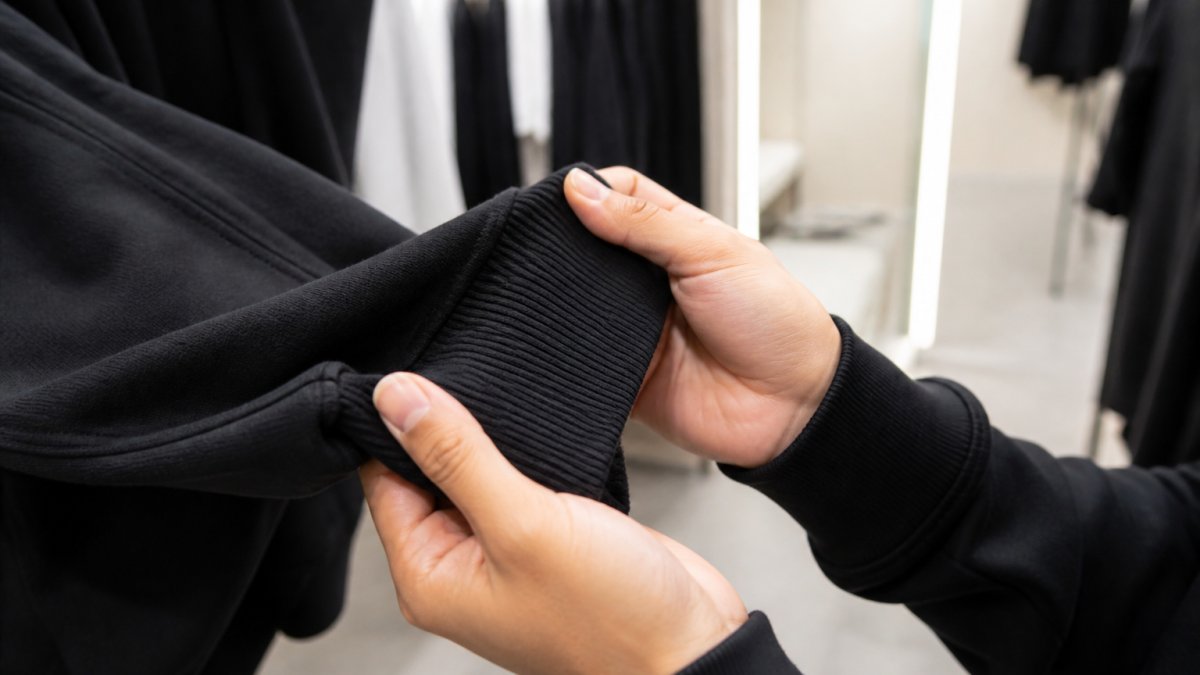
- Stretch the cuff. Good ribbing snaps back. Cheap ribbing stays stretched.
- Scratch the print. A soft-hand print flexes with the fabric. A rubbery print cracks.
- Read the tag. Composition and care instructions tell you more than the hangtag marketing.
For a deeper walkthrough of each check, our guide to spotting high-quality streetwear goes garment by garment.
Streetwear Fabric Quality Guide: Weight, Composition, and Hand Feel
Streetwear fabric quality is determined by three measurable factors: weight in ounces per square yard, fiber composition, and hand feel after washing. Get those right and most other quality questions answer themselves.
Fabric Weight and Ounces per Square Yard
Fabric weight is the single most reliable quality signal in streetwear. A 10.0 oz/yd² heavyweight fleece, like the IND4000 blank behind our Triple-Hit hoodie, has enough mass to hold a boxy silhouette and resist the wash-cycle thinning that turns cheap hoodies into rags. Budget fleece typically lands between 5 and 7 oz/yd². That is not automatically bad, but it will not drape the same way after twenty washes.

Cotton, Blends, and What Shrinkage Tells You
Composition matters as much as weight. A 100% cotton face over a cotton-poly fleece body, which is what the IND4000 uses at 70/30, gives you a dense surface for sharp prints and a structure that resists pilling. Blended fabrics can feel softer on day one, but lower cotton content often means more shrinkage and faster pilling. Check the care label: pre-laundered blanks shrink less, and a brand confident in its fabric will tell you so.
Construction Quality and Stitching: Where Budget Garments Fail First
Construction quality is where budget garments fail first, and where the price gap is most justified. The difference is not one big tell but a cluster of small ones: stitch density, seam type, thread choice, trim finishing, and reinforcement at stress points. A premium garment gets most of these right; a budget garment usually gets one or two right and cuts the rest.
Stitch Density and Seam Type
Stitch density is the fastest measurable signal. Premium pieces typically run 12 to 14 stitches per inch; budget pieces often sit at 8 to 10. Denser stitching distributes load across more thread loops, so a seam stretches instead of snapping. But density alone is not enough, the seam type matters just as much. Look for split-stitch double-needle sewing on side seams, hems, and armholes.
Stress Points: Where to Look First
Turn the garment inside out and check five places in this order: the neckline, the cuff-to-sleeve join, the waistband, the pocket corners, and the crotch or gusset on bottoms. These are the load-bearing points. Premium construction shows up as twill neck tape covering the back neck seam, heavy 1x1 ribbing with spandex for stretch recovery at cuffs and waistbands, and reinforced pocket corners. Budget construction often skips the twill tape entirely, uses lighter ribbing that stays stretched after a few wears, and leaves pocket corners with a single stitch line. Our Triple-Hit hoodie uses split-stitch double-needle seams, twill neck tape, and reinforced pouch stress points, the three details that most often separate tiers.
Thread, Trims, and Finishing
Thread choice is invisible until it fails. Premium garments tend to use bonded or core-spun thread that resists abrasion; budget garments often use standard spun polyester that fuzzes and breaks. Trim finishing is the other quiet tell: clean overlock inside seams, flat-felled or taped seams on heavier pieces, and no loose thread tails at the seam ends. Zippers and drawcords matter too, a premium hoodie usually has a metal or heavy molded zipper with a finished pull, while a budget hoodie may use a lightweight nylon coil that catches and separates.
A Quick Construction Test You Can Run in the Store
Grip the seam at the cuff and pull firmly in opposite directions. A well-built seam recovers and shows no gap; a weak seam opens and stays open. Then scratch the inside of the neckline, if you feel scratchy, untaped seam allowance, the garment skipped neck tape. Finally, check the hem for a clean double-needle finish rather than a single row.
Fit, Silhouette, and Print Quality: The Details That Separate Tiers
Fit and print quality separate the tiers in ways you notice every time you wear the piece. Silhouette is a design decision, not a quality one: a boxy, dropped-shoulder cut and a slim cut can both be well made.
Print quality is the other tell. High-density, soft-touch DTF transfers flex with heavyweight fleece without cracking or feeling rigid. Cheap prints sit on top of the fabric like a sticker and fail at the first wash.
STATIC & SUN CORE // "Triple-Hit" Heavyweight IND4000 Hoodie →
Is Designer Streetwear Worth It? Cost Per Wear and Long-Term Value
Designer streetwear is worth it when the cost per wear beats the budget alternative, and not before. But the honest version of that math needs three inputs most comparisons skip: a realistic price band, an expected lifespan, and the number of wears you will actually get. Run those transparently and the answer often flips by category rather than by brand tier.
Price Bands and the Cost-Per-Wear Formula
Compare prices within the same garment category.
The formula is simple: cost per wear = price ÷ number of wears before the garment fails or leaves your rotation. A $26.99 tee worn 60 times costs about $0.45 per wear. A $120 designer tee worn 80 times costs $1.50 per wear. The premium only wins if it lasts long enough and you actually wear it. A common pattern is that buyers overestimate premium lifespan and underestimate how often they reach for a budget piece they like.
Lifespan Assumptions by Category
Lifespan is where the comparison gets honest. Most practitioners find that a well-constructed heavyweight hoodie can hold shape through 50-100 washes, while a budget fleece may thin or pill within 20-30. Tees are harsher: a premium combed ring-spun tee may hold its neckline and print through 50-80 washes, while a budget tee often shows collar stretch and print cracking within 15-25.
Where Premium Wins and Where It Does Not
Premium wins on cost per wear when the garment is a high-frequency staple: a hoodie you wear weekly, a tee you rotate daily, denim you live in. Nearly 60% of streetwear consumers say they will pay a premium for exclusivity and authenticity, according to Cognitive Market Research's streetwear analysis, that is a real signal, but it is about perceived value, not construction.
A Transparent Value Calculation You Can Copy
Pick the garment you wear most. Write down its price, estimate how many times you will wear it in a year, and estimate how many years it will last. Multiply wears per year by years, then divide price by that total. Do the same for the budget and premium options in the same category. The lower number is the better value, and if the premium option is within about 20% of the budget option on cost per wear, the construction and fit usually justify the difference.
Premium Streetwear Brands Under $100: What That Budget Really Buys
GOODVIBE offers listed products under $100, including tees and a heavyweight hoodie. For a closer look at what the label actually offers, see the Frequency Interrogation (FAQ).
The Circuit Trace tee and 16-Bit Breach tee are listed at $26.99 and use the American Apparel 2001CVC blank, with a 60% combed ring-spun cotton / 40% polyester blend. The Triple-Hit hoodie is listed at $59.99.
Building a High-Quality Rotation from the GOODVIBE Inventory
Building a high-quality rotation starts with fewer, better pieces you wear often. A workable core: one heavyweight hoodie, two or three CVC tees, and a youth piece if you are buying for family.
Here is how we would build it. Start with the Triple-Hit hoodie as your outer layer, since 10 oz fleece covers the widest temperature range. Add the Circuit Trace and 16-Bit Breach tees for daily rotation.
Frequently Asked Questions
What is the difference between premium and budget streetwear?
Streetwear garments can differ in fabric weight, seam construction, print execution, and fit. The GOODVIBE Triple-Hit hoodie is listed at 10.0 oz/yd². Check the product specifications before you decide.
How can you tell if streetwear is good quality before buying online?
Check the garment blank name and fabric weight in oz/yd² or GSM. The GOODVIBE Triple-Hit hoodie listing names the Independent Trading Co. IND4000 blank and gives its weight as 10.0 oz/yd². Check the product listing for the specifications it provides.
Is designer streetwear worth it compared with cheaper alternatives?
It depends on wear frequency. Divide the price by the number of times you will actually wear the piece. A $60 hoodie worn 60 times costs $1 per wear. Nearly 60% of streetwear consumers say they will pay a premium for exclusivity and authenticity, per Cognitive Market Research. Judge the garment, not the hype.
Can budget streetwear be good quality?
Yes, sometimes. One analysis argues construction can be similar or identical between affordable alternatives and high-end products, with price differences driven by marketing budgets and artificial scarcity. Mid-market products held 43.58% of consumer streetwear spending in 2026 according to Mordor Intelligence.
What should I check before buying streetwear online?
Four things: the fabric weight and composition, the seam construction, the return policy, and the size chart with actual body measurements. Check the product listing for its stated print method and care instructions. If the brand publishes none of this, consider whether you have enough information to decide.
The challenge is simple: most streetwear shoppers cannot tell a 10 oz fleece from a 6 oz one until it is too late. GOODVIBE builds on verifiable blanks, with heavyweight IND4000 fleece, side-seamed CVC tees, and reinforced construction you can inspect in the product specs. Browse the CORE and RETRO CORE lines and check the fabric weight before you commit. Get started with GOODVIBE and build a rotation that holds its shape.
