
Last Updated: November 4, 2026
Quick Summary
Build a streetwear wardrobe by starting with proportions, not trends, and aiming for roughly 15 pieces: 4 to 5 tees, 2 hoodies, 3 to 4 bottoms, and 2 to 3 pairs of footwear. Every piece should pair with at least three others, and beginners should start with five pieces worn for one week before expanding.
- The global streetwear market is projected to reach $397.97 billion in 2026, per Fortune Business Insights.
- Clothing made up 51.54% of 2025 streetwear revenue, so spend there first.
- Follow a four-week build: two plain tees, one hoodie, straight-leg denim, then sneakers.
- Keep one oversized piece per outfit; two reads as a costume.
- Lay a new item next to your closet and buy only if it pairs with three or more pieces.
Table of Contents
- Start With Proportions, Not Trends
- Streetwear Wardrobe Essentials You'll Actually Wear
- How to Build a Streetwear Wardrobe for Beginners
- The Streetwear Capsule Wardrobe: Do the Math First
- Streetwear Outfits on a Budget Without Looking Cheap
- Layering and Seasonal Transitions That Hold Up
- Fit, Fabric, and the Quality Check Before You Buy
- Build Your Rotation From the GOODVIBE CORE Line
- Frequently Asked Questions
Start With Proportions, Not Trends
The global streetwear market is projected to reach $397.97 billion in 2026, according to Fortune Business Insights market forecast. That number tells you one thing: there is no single streetwear look anymore. So how do you build a streetwear wardrobe that actually works? You start with proportions, not trends.
At GOODVIBE, we see the same mistake on repeat. People buy hype pieces first and figure out fit later. That order is backwards.
Proportions are the relationship between your top, bottom, and shoes. Get that right and almost any piece works.
Three rules cover most of it:
- Boxy top, slim bottom. A heavyweight hoodie over straight-leg denim.
- Slim top, wide bottom. A fitted tee over cargo pants.
- One oversized piece per outfit. Two is a costume.
A 2026 street-style guide from Multiversity Store makes the same point: clear proportions and strong basics beat chasing one "approved" look.
Streetwear Wardrobe Essentials You'll Actually Wear
A working streetwear wardrobe needs roughly 15 pieces. That is the number Hot Off Wardrobe's practical wardrobe guide recommends: 4 to 5 tees, 2 hoodies, 3 to 4 bottoms, and 2 to 3 pairs of footwear.
That is it. Fifteen pieces, mixed well, cover a full week.
Tees, Hoodies, and Bottoms That Do the Work
Clothing made up 51.54% of 2025 streetwear revenue, per Portugal Clothing Factory's market analysis. That is where your money should go first.
- Tees: 4 to 5, mixing blank and graphic. Our Circuit Trace CVC tee is a 60/40 combed ring-spun cotton blend with a modern side-seamed cut.
- Hoodies: 2, one pullover and one zip. The Triple-Hit IND4000 hoodie runs 10.0 oz heavyweight fleece with a boxy, dropped-shoulder drape.
- Bottoms: 3 to 4. Cargo pants and straight-leg denim carry the most outfits.
Footwear and Headwear That Anchor the Fit
Footwear sets the tone. Two to three pairs is plenty: a clean low-profile sneaker, a chunkier runner, and one pair you don't mind scuffing.

Headwear finishes the silhouette. A tall-crown trucker adds height; a cuffless beanie keeps it tight. Our accessories line covers both, including the Dual Frequency retro trucker on a Yupoong 6609 chassis.
How to Build a Streetwear Wardrobe for Beginners
Start with five pieces and one week of outfits. That is the fastest way to learn what you actually reach for.
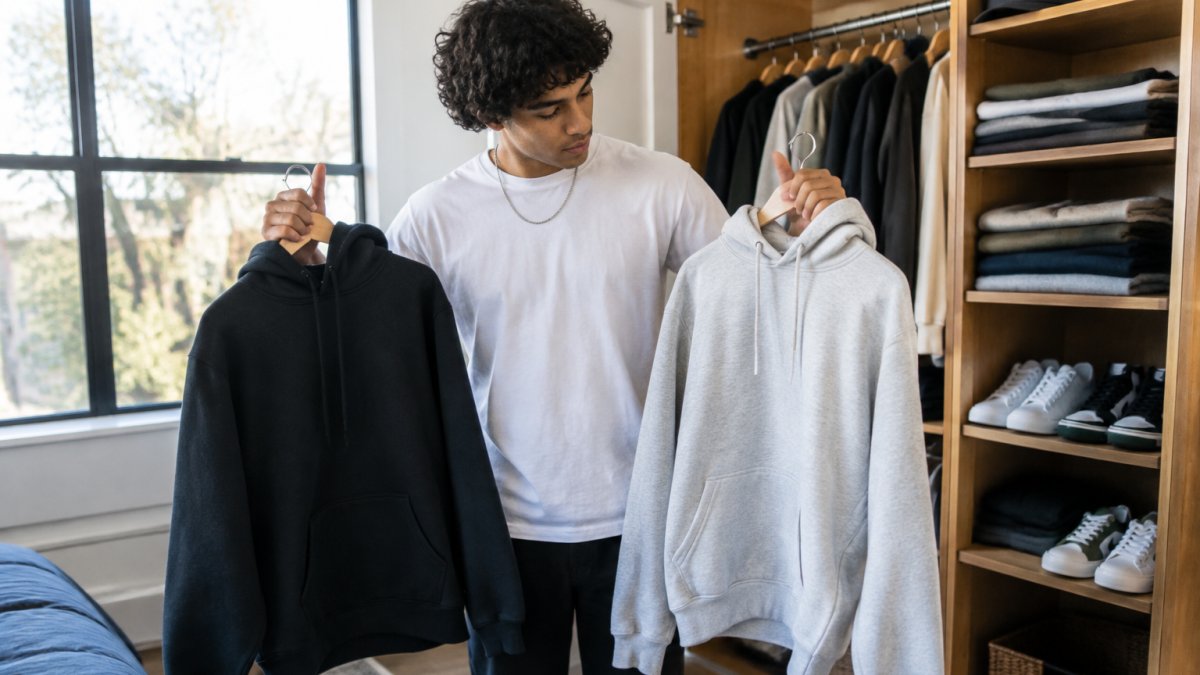
Here is the order we recommend, mapped to a four-week build so you are not guessing:
- Week 1, Buy two plain tees. Neutral colors first (white, black, heather grey, or sand). Wear each twice before buying more.
- Week 2, Add one hoodie. Pick your layering weight: a midweight pullover for year-round use, or a heavyweight zip for cold-weather layering.
- Week 3, Get one pair of straight-leg denim. It works with everything and sets your bottom silhouette.
- Week 4, Add one pair of sneakers. Clean, low-profile, and in a color that repeats in your tops.
- Wear only those five pieces for seven days. Note what you missed, what felt wrong, and what you reached for twice. That list is your next buy.
Then fill the gaps one piece at a time. A 2026 beginner guide from Sullen Clothing lists relaxed fits, neutral and earthy colors, and utility details as the current direction. Those are safe first buys.
Adjust the Build for Your Body Type
Streetwear's oversized silhouette is where beginners get lost, because the same boxy hoodie reads differently on a 5'6" frame than on a 6'2" frame. The fix is usually not avoiding oversized pieces but controlling where the volume sits.
- Shorter frames (under 5'8"): Keep the oversized piece on top and the bottom slim or straight. A cropped or hip-length hoodie over tapered denim preserves leg length. Avoid longline tees that hit mid-thigh.
- Taller frames (over 6'0"): You can carry wide bottoms and boxy tops together, but break the vertical line with a layered hem or a cropped jacket so the outfit does not read as one long column.
- Broader shoulders or chest: Drop-shoulder hoodies work in your favor, but check the sleeve length. A shoulder seam that sits past the deltoid by more than two inches starts to swallow the arm.
- Fuller midsection: Choose heavyweight tees that drape rather than cling, and use an open overshirt as a vertical framing layer instead of a tight hoodie.
Watch out: buying oversized everything in week one is the most common beginner mistake. One oversized piece per outfit is the rule until you can see how volume balances on your own frame.
Test Before You Expand
Before you buy piece six, run a simple compatibility check: lay the new item next to every piece you already own. If it pairs with fewer than three, it is not a beginner staple. If it pairs with five or more, it is doing real work in your rotation. This test is faster than a return policy and it stops the closet from filling with one-outfit pieces.
The Streetwear Capsule Wardrobe: Do the Math First
A streetwear capsule wardrobe is a small, fixed set of pieces that all work together. The math is simple: 15 pieces, and each one must pair with at least three others.
Run that test before you buy. If a piece only works with one outfit, it isn't a staple. It's a costume.
Use this breakdown:
| Category | Pieces | Target Spend Share |
|---|---|---|
| Tees | 4-5 | 15% |
| Hoodies | 2 | 25% |
| Bottoms | 3-4 | 30% |
| Footwear | 2-3 | 25% |
| Headwear | 1-2 | 5% |
The Mix-and-Match Matrix
Here is the part most capsule guides skip: the actual outfit count. Take a 15-piece capsule with 5 tees, 2 hoodies, 3 bottoms, 3 footwear options, and 2 headwear pieces. If every top works with every bottom, that is 7 tops × 3 bottoms = 21 base outfits before footwear and headwear. Add 3 footwear options and you have 63 combinations; add 2 headwear pieces and the number passes 120. You will not wear all of them, but the point is that a small, compatible set produces more usable outfits than a large, mismatched one.
STATIC & SUN CORE // "Triple-Hit" Heavyweight IND4000 Hoodie →
The constraint is compatibility, not quantity. A 30-piece wardrobe where only half the pieces pair with each other produces fewer real outfits than a 15-piece capsule where everything works.
Five Outfit Formulas to Run First
Once your capsule is built, these five formulas cover most of the week and show you where the gaps are:
- Heavyweight tee + straight-leg denim + low-profile sneaker. The baseline. If this does not look right, fix fit before buying anything else.
- Hoodie + cargo pant + chunky runner. The volume play. Keep the hoodie as the only oversized piece.
- Tee + open overshirt + denim + sneaker. The layering formula for transitional weather.
- Hoodie + straight-leg denim + low-profile sneaker + beanie. The cold-weather compression of formula 1.
- Graphic tee + cargo pant + chunky runner + trucker hat. The statement outfit, used sparingly.
If a formula fails, the problem is usually one piece, not the whole capsule. Swap the failing piece and rerun the formula before you add anything new.
The Three-Pairing Test in Practice
When you are considering a new piece, do not ask "do I like it?" Ask "what three existing pieces does this pair with?" Write the three down. If you cannot name three without stretching, the piece is a costume, not a staple. This single test is what keeps a capsule from drifting back into a random closet.
Streetwear Outfits on a Budget Without Looking Cheap
Cheap-looking outfits usually fail on fit, not price. A $26 tee that fits beats a $90 tee that doesn't.
Four ways to stretch a budget:
- Buy blanks in neutral colors. They mix with everything.
- Spend on the piece people see most. That's usually the hoodie or shoes.
- Skip logo-heavy pieces. They date fast and read as try-hard.
- Shop secondhand for outerwear. Vintage is one of the named 2026 directions.
Quality over quantity is the whole game here. Three good pieces beat eight weak ones every time.
Layering and Seasonal Transitions That Hold Up
Layering is how a 15-piece rotation survives four seasons. The formula: base layer, mid layer, outer shell.
For warm months, a tee plus an open overshirt works. For cold, a heavyweight hoodie under statement outerwear does the job.
Textural contrast matters more than color matching. Pair a smooth cotton tee with a fleece hoodie and you get depth without extra pieces.
Watch out: layering two oversized pieces flattens your silhouette. Keep one layer structured.
Fit, Fabric, and the Quality Check Before You Buy
Fabric weight and stitch quality decide whether a piece survives 50 washes. Check both before you spend.
Run this checklist in the store or on the product page:
- Fabric weight listed in oz or GSM
- Cotton face on fleece, not brushed polyester
- Shoulder-to-shoulder taping on tees
- Double-stitched hems
- Print method named, not just "printed graphic"
For a deeper breakdown, read our guide on what quality actually costs and our walkthrough on how to spot high-quality streetwear.
One honest note: a higher price doesn't guarantee better fabric. Check the spec sheet, not the price tag.
Build Your Rotation From the GOODVIBE CORE Line
GOODVIBE sits between SoCal streetwear culture and the XRPL digital frequency. Our CORE line is built for exactly the rotation this guide describes.
The Triple-Hit hoodie uses 10.0 oz IND4000 fleece, the Circuit Trace tee uses a 60/40 CVC blend, and the headwear is built on Yupoong chassis.
Frequently Asked Questions
How many pieces do you need for a streetwear wardrobe?
A practical starting point is about 15 pieces: 4 to 5 tees (a mix of blank and graphic), 2 hoodies (one pullover, one zip), 3 to 4 bottoms, and 2 to 3 pairs of footwear. That count covers a daily rotation without forcing you to do laundry every three days. From there, add outerwear and accessories as your budget allows. The goal is a streetwear wardrobe where every piece pairs with at least three others, so getting dressed stays fast.
What are the streetwear wardrobe essentials for a beginner?
Start with a graphic tee or two, a heavyweight hoodie, straight-leg denim or cargos, and a clean pair of trainers. Add a cap or beanie for cohesion, and one statement outerwear piece for colder months. Neutral colors make the first few pieces easier to mix, while one loud graphic keeps the rotation from looking flat.
How do you build a streetwear capsule wardrobe on a budget?
Buy fewer, heavier pieces and repeat them. GOODVIBE's Triple-Hit IND4000 hoodie is priced at $59.99 and is built on a 10.0 oz heavyweight fleece. Mix one or two statement pieces with blank basics, shop second-hand for denim and outerwear, and set a rule that each new item must pair with three things you already own. That approach keeps a capsule tight and avoids impulse buys.
How do you make streetwear outfits look cohesive?
Cohesion comes from repeated proportions and a limited color range, not from matching logos. Pick one silhouette family (boxy top with straight or relaxed bottom) and stay inside a palette of two neutrals plus one accent. Textural contrast helps too: pair a heavyweight fleece hoodie with a lighter tee underneath so the layers read separately. A 2026 street-style guide describes the direction as clear proportions, useful layers, and strong basics, which is a reliable test for any outfit you put together.
Building a wardrobe that works takes discipline, not hype. Start with proportions, buy 15 pieces that pair with each other, and check the fabric before the logo.
GOODVIBE can supply the foundation. Our CORE line gives you heavyweight fleece, side-seamed tees, and structured headwear built to mix. Get started with GOODVIBE and build a rotation that holds up past the season.
